
York County Criminal Court Records
Criminal court records in York County are maintained by the York County Clerk of Courts for Court of Common Pleas criminal division matters. The county says the office maintains docketing and events for about 8,000 to 9,000 criminal cases per year, schedules court events at the court's direction, and collects about $12 million in costs, fines, and restitution from criminal defendants each year. The office also handles juvenile court records, summary convictions, expungements, and several non-case filings assigned by county practice.
The York County Court of Common Pleas is the trial court for major criminal cases. Magisterial District Judges handle minor criminal cases, preliminary arraignments, bail, and preliminary hearings. Many misdemeanor and felony cases begin at the MDJ level and move to Common Pleas if the charges are held for court. The full criminal case file and outcome belong here, while the narrower charge path after arrest is treated separately in York County arrest records and court charges.
The Clerk of Courts page is the local source for criminal division record responsibilities.
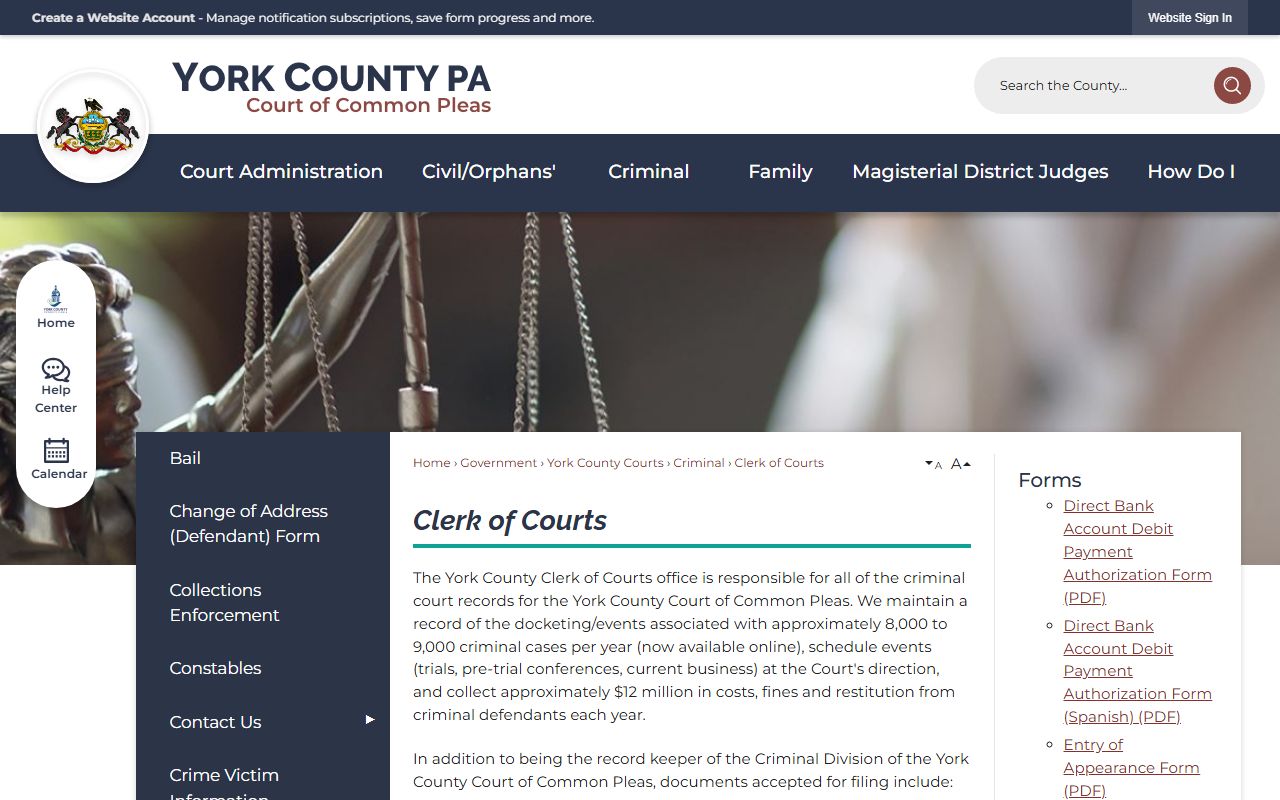
That office is the correct local contact when a public criminal docket points to a document that is not available online.
Search York County Criminal Records
Use Pennsylvania UJS Case Search for York County criminal docket sheets. UJS supports searches by docket number, participant name, OTN, complaint number, incident number, date filed, calendar event, and other fields. The county research confirms that docket sheets for York County and all Pennsylvania counties are available through UJS, while full criminal documents are handled by the Clerk of Courts.
- Open UJS Case Search and choose a search type tied to the criminal record, such as Docket Number, Participant Name, OTN, Complaint Number, or Calendar Event.
- Select York as the county when a county filter appears, or use York - 19 as the judicial district when needed.
- Compare the defendant name, docket number, filing date, court office, charges, and OTN before relying on a result.
- Read the docket from first filing through current status, including bail, preliminary hearing, plea, trial, sentence, and payment entries.
- Request public documents from the Clerk of Courts by office visit or by email with the docket number and document type.
Criminal court dockets should not be used as a criminal-history background check. UJS cites the Criminal History Record Information Act and warns employers not to treat docket sheets as the same thing as a Pennsylvania State Police history record.
York County Criminal Case Flow
A York County criminal case often starts with an arrest or complaint, then moves through MDJ events before Common Pleas proceedings. The record may show bail, an arraignment, a preliminary hearing, charges held for court, an information filed by the prosecutor, pretrial motions, plea or trial, disposition, sentence, and later probation or parole violation entries.
Case flow: Charges Filed › Arraignment › Preliminary Hearing › Pretrial / Motions › Plea or Trial › Disposition › Sentencing
| Stage | What Happens |
|---|---|
| Charges Filed | The complaint or charging record starts the court trail and may include statutes, grading, OTN, arresting agency, and offense facts. |
| Arraignment and Bail | The court addresses rights, release terms, bail, and next events. |
| Preliminary Hearing | The MDJ decides whether the prosecution has enough proof for charges to move forward. |
| Pretrial and Motions | Common Pleas entries may show counsel, filings, hearings, continuances, and court orders. |
| Plea or Trial | The record shows a plea, verdict, dismissal, acquittal, or other resolution. |
| Sentencing | The docket may show sentence, probation, parole terms, fines, costs, restitution, and payment plan information. |
York County Criminal Record Fields
A criminal court record should be read field by field. A charge line is not the same as a conviction line. The docket may list several charges tied to one arrest, and each charge may have its own grading, statute, status, plea, or disposition. Later entries can change the status through amendment, dismissal, plea, trial, sentence, or expungement activity.
| Field | What It Shows |
|---|---|
| Docket Number | The Court of Common Pleas or MDJ case identifier. |
| Defendant | The accused person listed in the public criminal case record. |
| OTN / Complaint / Incident Number | Cross-reference numbers used to connect the criminal matter to charging and law-enforcement records. |
| Charges | Offense names, statute references, grading, and charge status when public. |
| Bail and Arraignment | Release status, bail entries, and early court events. |
| Plea and Trial Entries | Guilty, not guilty, negotiated plea, trial result, or other case outcome entries. |
| Disposition and Sentence | Final result, sentence terms, probation, fines, costs, restitution, or payment obligations. |
The York County District Attorney's public site describes the prosecution function tied to these records.
The prosecutor's role explains why a criminal docket may change as charges are reviewed, amended, resolved, or dismissed.
York County Charges vs Convictions
A charge is an accusation filed in court. A conviction is a final result based on a guilty plea, verdict, or qualifying adjudication. York County criminal court records may show charges that were withdrawn, dismissed, reduced, amended, or resolved without a conviction. Reading only the first charge list can give the wrong picture.
| Point | Charge | Conviction |
|---|---|---|
| Meaning | An allegation that an offense was committed. | A final court result based on plea or verdict. |
| Where It Appears | Early docket entries, complaint, information, or charge list. | Disposition, plea, verdict, sentencing, and judgment entries. |
| Can Change | Yes, charges may be amended, reduced, withdrawn, or dismissed. | Usually changes only through appeal, post-sentence relief, expungement, or later court order. |
York County Criminal Offices
The York County District Attorney prosecutes misdemeanor, felony, and homicide cases before the Court of Common Pleas, supports local police, assists victims, and handles probation or parole violations, juvenile delinquency, criminal contempt, appeals, and criminal investigations. The county directory lists the DA office at the Judicial Center. Timothy J. Barker was sworn in as District Attorney on January 17, 2025.
The York County Public Defender represents indigent adults and minors charged with criminal offenses and contempt proceedings where loss of liberty is possible. Applications may be submitted at the Judicial Center Monday through Thursday during the listed application window, and applicants should bring current case paperwork and proof of income. Conflict Counsel handles qualified adults and juveniles when the Public Defender has a conflict.
The District Attorney biography page documents the current elected prosecutor for York County criminal cases.
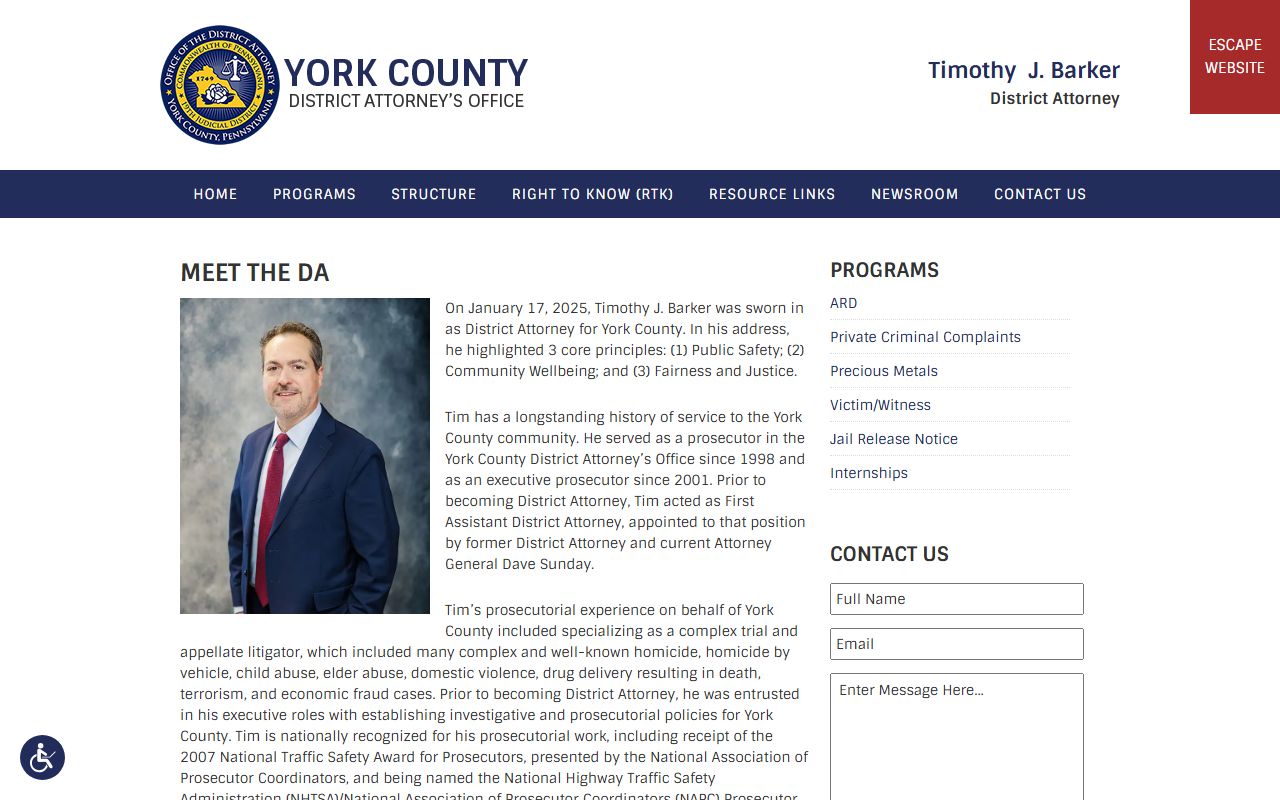
The named prosecutor and office can matter when reading filings, plea offers, and Commonwealth entries in a docket.
The county directory supplies the official District Attorney contact block.
That directory helps separate court-file access from prosecution office contact needs.
Access York County Criminal Records
Criminal docket sheets are public through UJS unless restricted by court rule or order. Full public criminal documents are not all delivered through the docket sheet. The Clerk of Courts allows public documents to be viewed in person, and also accepts email requests at CoCRecordsRequest@YorkCountyPA.gov when the requester provides a docket number and document type.
204 Pa. Code Section 213.81 governs public access to Pennsylvania case records. Pennsylvania Right-to-Know Law may apply to agency records, but court case records also follow judiciary policy. UJS cautions that public docket sheets are not a substitute for criminal-history records under 18 Pa.C.S. Section 9101 et seq.
Note: Use the docket to identify the case, then ask the Clerk of Courts for public documents not shown online.
Sealed vs Expunged Criminal Records
Sealing or limited access blocks public viewing of a record, but the record may still exist for court or law-enforcement purposes. Expungement can remove, destroy, or limit eligible criminal-history records under a court order. The practical first step is to identify the York County docket, charges, OTN, arrest date, arresting agency, and disposition, then compare the outcome with Pennsylvania law.
| Point | Sealed or Limited Access | Expunged |
|---|---|---|
| Public View | Blocked or limited by rule, order, or statute. | Removed or destroyed as the expungement order directs. |
| Record Existence | The file may still exist for court or agency use. | Agencies may be ordered to remove or destroy eligible records. |
| Authority | Public-access policy, court order, Clean Slate, or other limited-access rule. | Adult expungement under 18 Pa.C.S. Section 9122 or juvenile expungement under 18 Pa.C.S. Section 9123. |
Restricted York County Criminal Records
Juvenile criminal records are restricted. The Clerk of Courts receives juvenile court records, but public access is limited. 42 Pa.C.S. Section 6308 restricts disclosure of juvenile law-enforcement records except in defined circumstances. Victim, witness, and juror identifying information can also be blocked from remote public access under the case records policy.
Dismissed, withdrawn, or acquitted charges may still appear on a docket unless sealed, expunged, or otherwise limited by law. That is why the disposition and sentence fields are more important than the first charge list. The public defender and counsel channels matter when a person needs advice about eligibility, pending cases, warrants, or expungement procedure.
The Public Defender office page explains York County representation for qualifying criminal defendants.
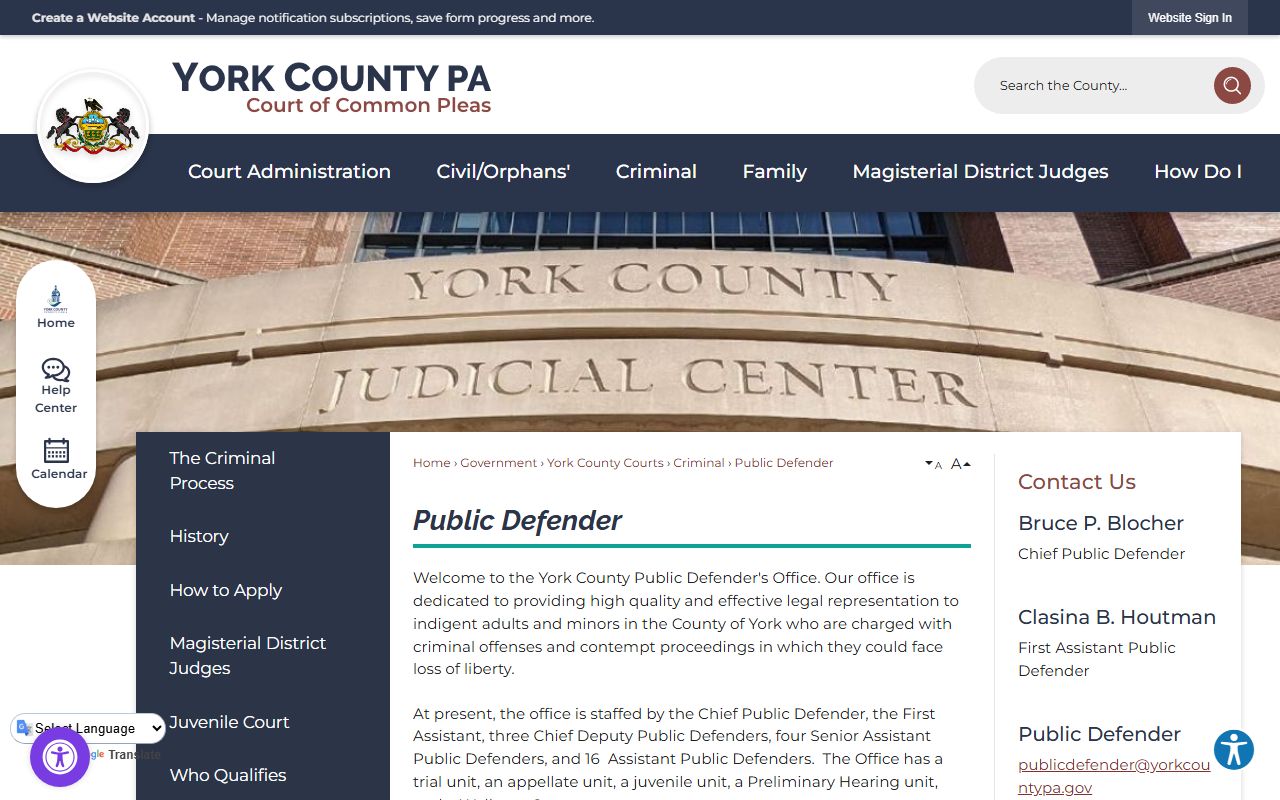
That office is tied to defense representation, not public record copying, but its paperwork can affect the criminal case file.
The Public Defender staff directory provides the official office contact details.
Use the directory contact when the question concerns representation or eligibility rather than docket lookup.